Articles
In Texas, fall arrives on our calendar well before we feel it in the weather. The days are still hot, but football is back, school is underway, and schedules are filling with the familiar rhythms of a new season. Wherever this note finds you, I hope you have enjoyed a restful summer and are entering the fall with renewed energy and anticipation for the months ahead.
Since the funding cuts initiated in April 2025, Humanities Texas has operated with less than half of the federal funding Congress appropriated for our work in FY 2025 and FY 2026. These cuts have required a thorough review of operations and difficult but necessary adjustments. Nevertheless, we remain firmly committed to our mission: to ensure that all Texans have access to programs and resources that deepen understanding of our shared history, culture, and civic life.
If you would like to help us continue this work, please consider making a gift to Humanities Texas.
I am pleased to share an update on Humanities Texas's recent activities and a few glimpses of what we are planning for the coming months.
Summer Programs for Texas Teachers
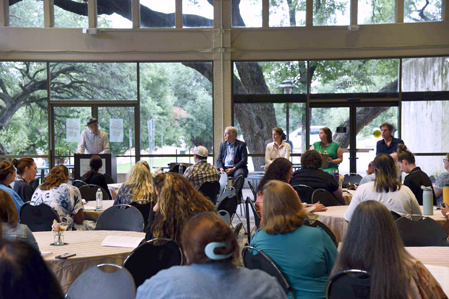
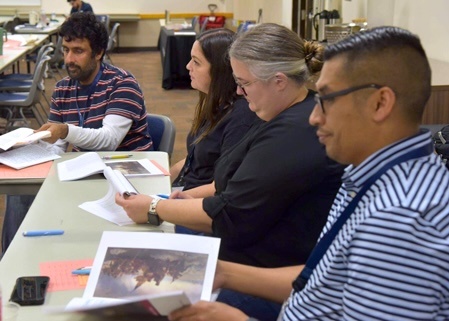
This summer, with continued support from the State of Texas, we held a range of engaging professional development programs for the state's social studies and language arts teachers.
The residential institutes we held in June included:
- "Digital Humanities Teaching Tools," held in Fort Worth in partnership with Texas Christian University's Center for Texas Studies. The program provided teachers with strategies to help students navigate new AI technologies, online educational resources, and digital archives.
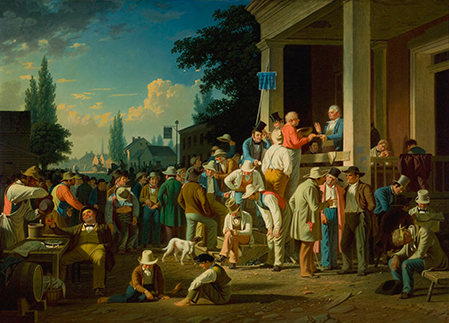
- "Teaching the American Revolution at 250" and "Teaching the American Literary Tradition at 250," both held in Austin in partnership with The University of Texas at Austin College of Liberal Arts.
- "Teaching World War I and World War II," held in College Station in partnership with Texas A&M University.
July webinars included a two-part series on teaching U.S. history through sports, a two-part series on resources from the University of North Texas's Texas History for Teachers project, and a three-part series on improving middle school students' reading skills.
We concluded our summer programming with a webinar held in partnership with the 9/11 Memorial and Museum. Participating teachers took a virtual tour of the museum in Lower Manhattan and received a wealth of curriculum resources aligned with Texas curriculum standards.
Teachers continue to describe our programs as among the best professional development available to them, particularly highlighting the opportunity to work closely with scholars on substantive topics in history, government, and language arts.
"Teaching the American Literary Tradition at 250" was unlike other professional development programs I have attended. Humanities Texas is unique because it brings together outstanding scholars, meaningful content, and a genuine community of educators who are deeply committed to the humanities. I have never experienced anything comparable; the program was phenomenal in both its intellectual depth and its inspiring atmosphere. — Teacher participant from Conroe, Texas
The Humanities Texas institute "Teaching the American Revolution at 250" was unique because it allowed us to learn directly from historians and scholars who are experts in their fields. Rather than focusing primarily on activities and pedagogy, the institute provided rich historical content, multiple perspectives, and opportunities to engage with primary sources. . . . What I valued most was that the institute helped me see the bigger picture. The presentations connected events, people, and ideas in ways that increased my own historical understanding and will ultimately make me a better teacher. I left with new content knowledge, new resources, and a renewed enthusiasm for teaching history. Few professional development experiences have had that kind of impact on me. — Teacher participant from Richmond, Texas
My colleagues and I are deeply proud that our programs continue to earn such high praise. We recently announced our fall offerings—which include programs on topics ranging from Hamlet to the Early American Republic to the Texas Revolution. More information is available on our website.
Outstanding Teaching Awards
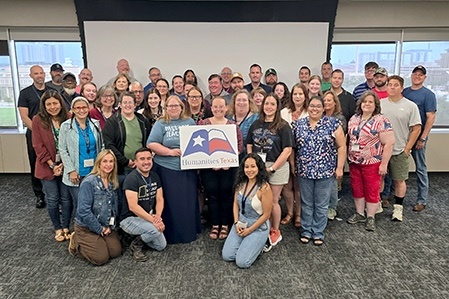
Earlier this summer, we announced the fifteen winners of our 2026 Outstanding Teaching Awards. The winning teachers teach in schools across the Austin, Corpus Christi, Dallas, Houston, and San Antonio metropolitan areas, as well as in the Rio Grande Valley (Pharr and Brownsville) and West Texas (Terlingua).
More than seven hundred teachers statewide were nominated for this year’s awards. During the 2026–2027 school year, each winning teacher will receive $5,000, with an additional $1,000 for their school to purchase humanities-based instructional materials. We will feature each of the 2026 winners in forthcoming issues of this newsletter.
We are now accepting nominations for the 2027 awards cycle.
Grants
Due to the drastic cut in our federal funding, we have had to significantly curtail mini-grants and cancel our major grant cycle for fall 2026. With generous support from several of the state’s leading foundations, however, we have continued awarding rural and exhibition grants to organizations across Texas.
Since launching the rural and exhibition grant lines in 2025, Humanities Texas has awarded nearly seventy grants supporting a wide range of public programs in rural areas—exhibitions, cultural festivals, summer reading programs, and public lectures, to name a few. Recent awardees include the Archer County Museum and Arts Center (Archer City), Brenham Heritage Center, the City of Snyder, the Silsbee Ice House Museum and Cultural Center, and Sul Ross State University (Alpine).
Traveling Exhibitions
Our traveling exhibitions program continues to serve communities statewide, providing libraries, museums, schools, and other community organizations with professionally developed humanities exhibitions that can serve as the foundation for public programs and educational activities.
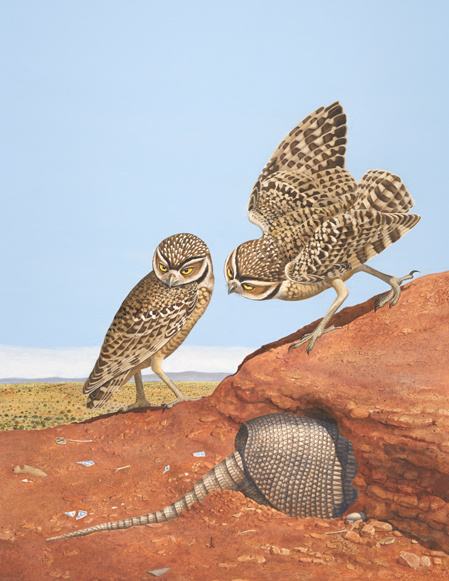
Earlier this summer, we introduced Of Birds and Texas: The Gentling Brothers and Their Magnificent Book and Legacies of the Treaty of Guadalupe Hidalgo. Another new exhibition, Homegrown: Austin Music Posters, 1967–82, will be available for rental later this year. We recently held a small preview of the exhibition in Austin, in conjunction with a public screening of the film Armadillo Man: The Trips of Jim Franklin.
For more information about renting a Humanities Texas exhibition, please contact a member of our exhibitions team.
Help Us Continue This Work
Humanities Texas has weathered real challenges this year, but as these examples show, our commitment to serving Texans remains unchanged. We are deeply grateful to the individuals, foundations, and partners who have helped sustain our work during this difficult period.
To help ensure these programs continue, please consider making a gift to our annual fund. Every contribution provides immediate, flexible support where it is needed most.
Thank you as always for your support.
Eric Lupfer